backpack telemetry

Texas A&M AgriLife Research Texas A&M AgriLife Extension Service College of Agriculture and Life Sciences Find abstracts and full-text online for our peer reviewed publications. Evaluation of a GPS backpack transmitter for wild turkey research Author(s): J. D. Guthrie, M. E. Byrne, J. B. Hardin, C. O. Kochanny, K. L. Skow, R. T. Snelgrove, M. J. Butler, M. J. Peterson, M. J. Chamberlain, B. A. Collier Radiotelemetry is the standard method for monitoring wild turkey (Meleagris gallapavo) movements and habitat use. Spatial data collected using telemetry-based monitoring are frequently inaccurate due to triangulation error. However, new technology, such as Global Positioning Systems (GPS) has increased ecologists’ ability to accurately evaluate animal movements and habitat selection. We evaluated the efficacy of micro-GPS backpack units for use on wild turkeys.We tested a micro-GPS developed specifically for avian species that incorporated a GPS antenna with a lightweight rechargeable battery and a very high frequency (VHF) transmitter.

We conducted a series of static tests to evaluate performance in varying types of vegetative canopy cover and terrain. After static testing, we deployedmicro-GPS on 8 adultmale Rio Grande wild turkeys (M. g. intermedia) trapped in south Texas and 2 adult females trapped in the Texas panhandle. Micro-GPS units collected 26,439 locations out of 26,506 scheduled attempts (99.7% fix rate) during static testing. Mean distance error across all static tests was 15.5 m (SE = 0.1). In summer 2009, we recovered micro-GPS from 4 tagged males and both females to evaluate data collection. Units on males acquired approximately 2,500 locations over a 65-day test period (94.5% fix rate). We recovered units from the 2 females after 19 days and 53 days; those units acquired 301 and 837 locations, respectively, for a 96% fix rate. Cost analysis indicated that VHF will be cost effective when 1 location per day is required up to 181 days, but micro-GPS becomes less expensive as frequency of daily locations increases.
Our results indicate that micro-GPS have the potential to provide increased reliable data on turkey movement ecology and habitat selection at a higher resolution than conventional VHF telemetric methods.
jockey backpack program Guthrie, J. D., M. E. Byrne, J. B. Hardin, C. O. Kochanny, K. L. Skow, R. T. Snelgrove, M. J. Butler, M. J. Peterson, M. J. Chamberlain, and B. A. Collier.
flcl backpack2011. Evaluation of a GPS backpack transmitter for wild turkey research.
highschool dxd backpackJournal of Wildlife Management 75:539-547
backpack mta Very high frequency (VHF) radio telemetry was the first real-time technique used to track individual animals from a distance.
backpack beutel
A transmitter attached to the study animal broadcasts pulsed signals in the VHF portion of the electromagnetic spectrum (30 to 300 MHz).
ucla backpack adidasStudy animals given unique frequencies, so that individuals can be followed. Researchers use specialized antennas and receivers to track study animals. Despite newer technologies that surpass the capabilities of VHF telemetry, the equipment continues to be a research staple. Moreover, a new application of VHF technology allows for automatic detection of tagged animals. See Automated Radio Telemetry section below. VHF tracking systems consist of three primary components (transmitter, antenna, and receiver), which work together to provide information about moving animals. VHF transmitters include four major parts: The weight of transmitters and the methods used to attach them to animals are among the most important considerations when designing a study.

This is especially true for highly mobile animals that can be hindered by heavy or binding equipment. One of the reasons VHF radio telemetry remains popular is because the lightweight transmitters can remain active for extended periods. Previous guidelines suggested that the weights of monitoring equipment should not exceed 3-5% of animal body weights. And for this reason, smaller and lighter transmitters extend the utility of radio telemetry based studies to smaller animals (0.6 gram transmitters now available). The transmission electronics are generally similar in most units, so weight differences are based on battery sizes. Larger and heavier batteries last longer, and some are designed to work for multiple years. Light transmitters with extremely small batteries have restricted operating lives of just a few weeks. Transmitters come in a host of shapes and configurations, and there are multiple techniques for attachment to a variety of taxa.Some are designed to eventually drop of the study animal.

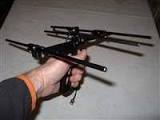
Antennas are used by the researcher to follow transmissions broadcasted from study animals. There are three general rules that apply to all receiver antennas. Like transmitters, receiving antennas range in type, size, and accuracy that each have benefits and drawbacks. The best antenna for a study is based on objectives, the directional accuracy needed, and the ability to access study areas by vehicle or foot. VHF receivers range from simple hand-held radio receivers to complicated devices with integrated computerized and automated recording equipment. As with receiving antennas, electronic receivers must be tuned to the correct range of frequencies. Receiving antennas are attached to the receiver via coaxial cable. Very basic receivers are similar to simple FM radios and require the user to tune it to a specific frequency. Modern receivers allow the user to enter the transmission frequency into a digital keypad. Some receivers are also constructed with scanning and logging capabilities or outputs for computers so that they can record the movements of many animals for extended periods.
In recent years, the increased use of personal wireless devices has caused interference in the range of the electromagnetic spectrum used for VHF radio telemetry. Problems are especially prominent in urban areas, where VHF telemetry signals can become difficult to detect. Manufacturers of VHF equipment have responded by releasing signal filtering devices that help remove some of the static that can come from other wireless devices. Simple presence and absence information inform investigators if animals are within reception range. For example, presence and absence data could be used to discern whether migrants are passing a fixed receiver system along a migratory pathway. Refined animal location information is the most common type of data sought by investigators, and there are two methods for determining precise animal locations. Field observers can use the equipment to guide them directly to the radio-marked study subject, i.e. observers home in on animals. By recording and mapping the bearing of an animal’s location from multiple angles, its position can be estimated.

Triangulation can be done by hand on a map, or with software programs designed for this purpose. Errors can also be approximated. Triangulation software is available for mobile devices and phones so that animal locations can be estimated in the field. Some of the most sophisticated tracking systems include vehicle-mounted antennas, with integrated magnetic compasses and computers that display triangulation calculations and animal locations on geographic information system maps. VHF signals can travel tremendous distances, but they can also be blocked when they encounter topography, water, or heavy vegetation. Thus, researchers often use the “line-of-sight” rule of thumb. The idea is that mountains, hills, or thick vegetation should not block an imaginary line connecting observers to study animals. In hilly landscapes, radio signals can bounce off hillsides, cliffs, or valleys. This can mislead observers away from study animals and render data unusable. Investigators sometimes avoid bounced signals by making observations from hilltops or observation towers.

In extremely rugged terrain, small planes or helicopters can also be used. 4. Automated Radio Tracking Recently developed radio transmitter and receiver technology now allow for automated tracking of animals at local, regional, and continental scales. Automated radio tracking systems are custom built in a variety of styles depending on their use, but essentially consist of: 1) an automated radio receiver, 2) one to four antennas, 3) the tower structure, and 4) a power source. A variety of antenna types (see above) can be used depending on the desired use. Automated radio systems can be affixed to existing structures (tall buildings, cell phone towers, etc.) or to stand-alone towers built by the user. Automated radio systems may be connected to an existing power source or may be solar powered for more remote locations. Detection data can be downloaded directly from the receiver unit. Alternatively, towers can be connected to wired or wireless internet, or communicate through cell phone technology, which allows for around the clock remote access to detection data.

Automated radio tracking systems take advantage of new coded transmitter technology. Unlike traditional radio transmitters which each emit a signal at a unique frequency, coded transmitters all emit a signal at the same frequency, but are uniquely identifiable. This allows the automated radio receiver to listen for hundreds of transmitters at the same time, vastly increasing the likelihood of detection, compared to traditional systems, which would have to cycle through each individual radio frequency. Automated radio towers can be arranged to track birds at local, regional, and continental scales. Dense arrays of radio towers can be used to track local movements and if animals are detected by multiple towers, triangulation (see above) can be used to provide precise movement data. Coordinated arrays of automated radio towers, such as those organized by Bird Studies Canada’s Motus Wildlife Tracking System, allow for tracking of animals at continental scales. Motus currently consists >300 receiving stations located across North America, with additional towers coming online each year.